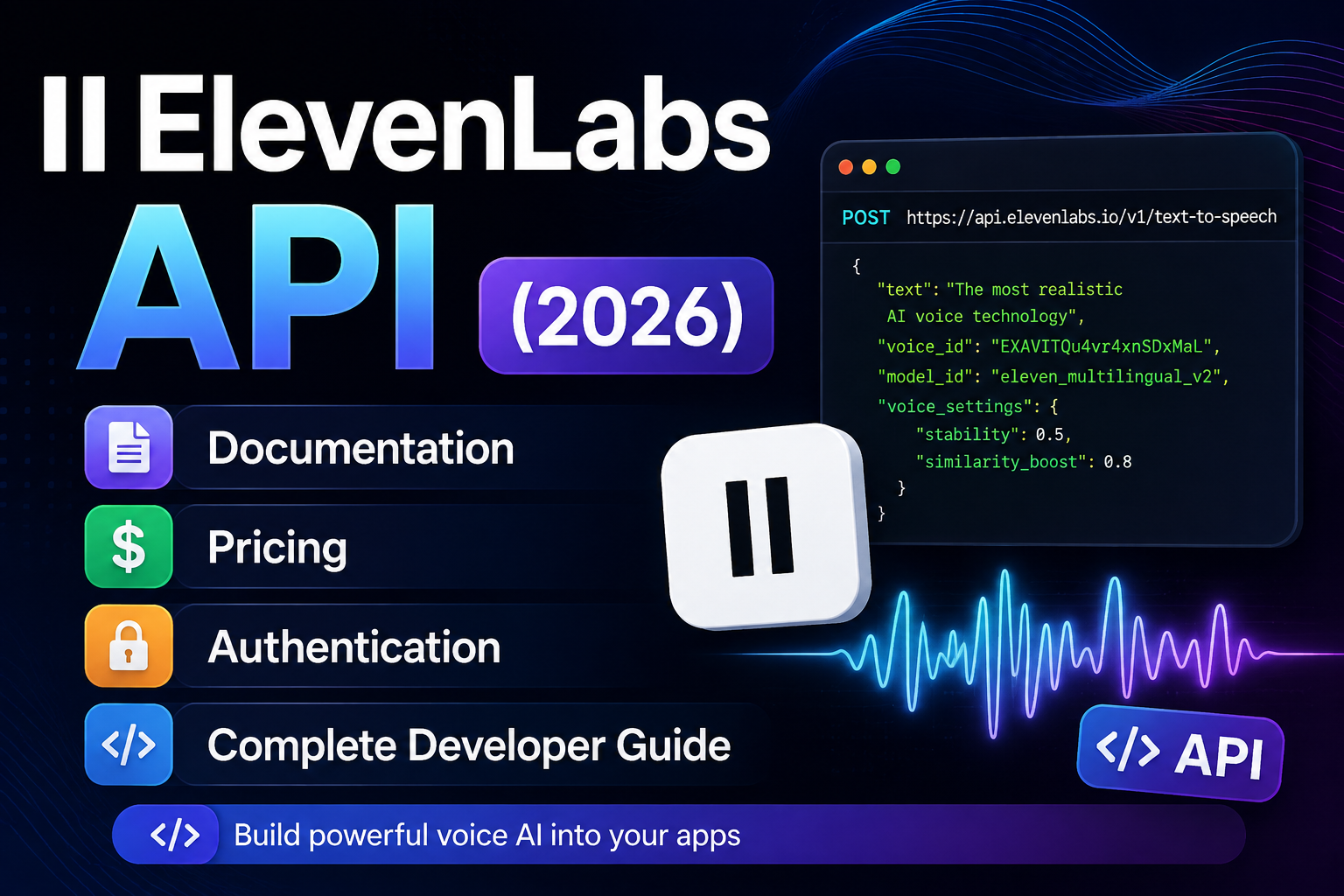
ElevenLabs API (2026): Complete Developer Guide
Artificial intelligence has transformed how developers build applications, and voice AI is one of the fastest-growing areas. Instead of recording voiceovers manually or relying on robotic text-to-speech engines, developers can now integrate realistic AI voices directly into their products using the ElevenLabs API.
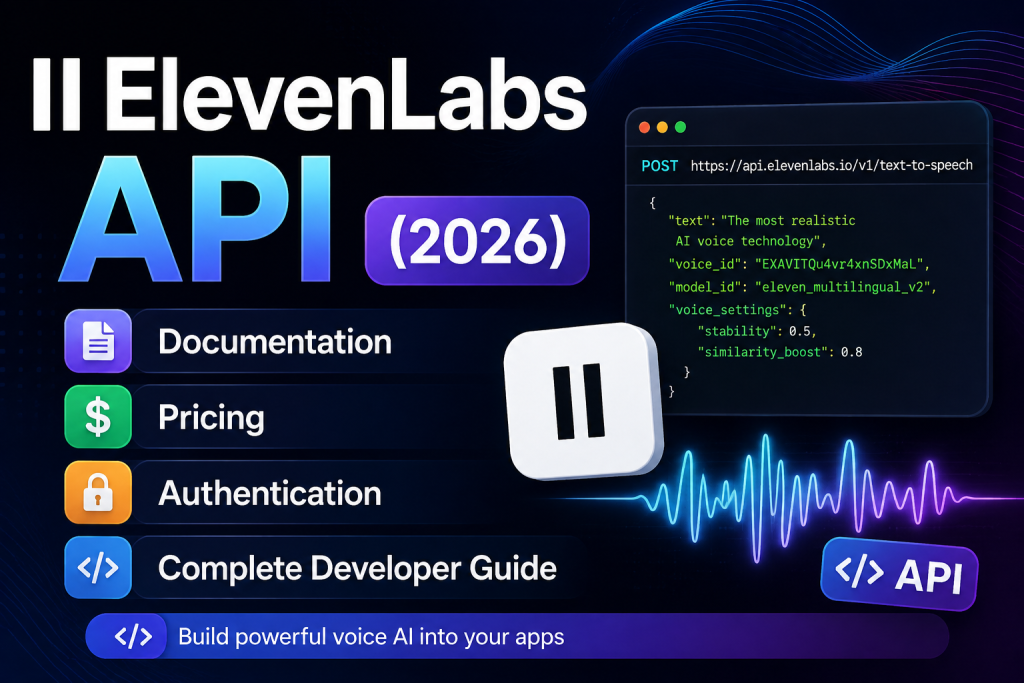
Whether you’re building an AI assistant, audiobook platform, customer support solution, language-learning app, or video automation workflow, the ElevenLabs API gives you access to industry-leading speech generation with just a few API calls.
If you’re new to ElevenLabs, read our ElevenLabs Review first.
In this guide, you’ll learn:
- What the ElevenLabs API is
- How authentication works
- Available endpoints
- Pricing considerations
- Best use cases
- Example requests
- Best practices
- Whether it’s worth using over competing AI voice APIs
What Is the ElevenLabs API?
The ElevenLabs API is a RESTful API that allows developers to integrate AI-powered voice generation into websites, mobile apps, desktop software, and backend services.
Instead of using the web interface, developers can generate speech programmatically by sending requests to the API.
Common use cases include:
- AI chatbots
- Audiobook generation
- Podcast automation
- YouTube narration
- Voice assistants
- E-learning platforms
- Customer support systems
- Accessibility tools
- SaaS products
- Mobile applications
Unlike traditional text-to-speech engines, ElevenLabs produces highly natural speech with realistic intonation, emotion, and pacing.
If you’re exploring other voice AI platforms, compare the leading options in our Best AI Voice Generators guide.
Why Developers Choose ElevenLabs API
The biggest reason developers choose ElevenLabs is voice quality.
Many text-to-speech APIs sound robotic, especially during long narrations. ElevenLabs uses advanced AI models to generate speech that sounds much closer to a real human.
Key benefits include:
- Natural pronunciation
- Emotional speech synthesis
- Multiple languages
- High-quality voice cloning
- Fast response times
- REST API
- SDK support
- Scalable infrastructure
- Regular model updates
For startups and SaaS businesses, this means less development time and a better user experience.
Main Features of the ElevenLabs API
1. Text-to-Speech API
The Text-to-Speech endpoint converts written text into realistic spoken audio.
Typical applications include:
- Video narration
- Audiobooks
- News readers
- Learning platforms
- Marketing videos
- Product demos
- Interactive assistants
Compared with many traditional TTS engines, ElevenLabs produces speech with far more natural rhythm and expression.
If you’re specifically researching text-to-speech tools, check out our Text to Speech Software guide.
2. Voice Cloning API
Voice cloning allows developers to create custom AI voices based on recorded audio samples.
Popular use cases include:
- Brand voices
- Digital presenters
- Personalized assistants
- Audiobook narration
- Character voices
- Gaming
Voice cloning should always be used responsibly and with proper consent.
Learn more in our AI Voice Cloning Software guide.
3. Multilingual Voice Generation
One of the platform’s strongest capabilities is multilingual support.
Developers can generate speech in numerous languages while maintaining natural pronunciation and pacing.
This makes the API ideal for:
- International businesses
- Localization platforms
- Online education
- Customer support
- Global marketing campaigns
Instead of managing multiple voice providers, developers can often handle multilingual projects using a single API.
4. Low-Latency Speech Generation
Applications such as conversational AI require fast response times.
The ElevenLabs API is optimized for low-latency generation, making it suitable for:
- Voice assistants
- AI receptionists
- Interactive learning
- Live applications
- Customer service bots
Reducing response time creates a more natural conversational experience for users.
5. High-Quality Audio Output
The generated audio is suitable for professional content creation.
Developers commonly use it for:
- YouTube narration
- Podcasts
- Online courses
- Product walkthroughs
- Marketing campaigns
- Corporate training
Many creators combine ElevenLabs with AI video tools to automate the entire production workflow.
If you’re creating AI-powered videos, read our Best AI Video Generators guide.
How the ElevenLabs API Works
At a high level, the workflow is straightforward:
- Create an ElevenLabs account.
- Generate an API key from your dashboard.
- Choose a voice ID.
- Send text to the Text-to-Speech endpoint.
- Receive an audio file in response.
- Save or stream the generated audio in your application.
This simple REST architecture makes the API easy to integrate into almost any programming language or framework.
Getting Your API Key
Before making API requests, you’ll need an API key.
The typical process involves:
- Sign in to your ElevenLabs account.
- Navigate to your account settings.
- Open the API section.
- Generate a new secret key.
- Store it securely.
- Never expose it in client-side code or public repositories.
Treat your API key like a password. If it’s compromised, regenerate it immediately and update your applications.
Authentication
Most API requests require authentication using your secret API key.
A typical request includes an authentication header similar to:
xi-api-key: YOUR_API_KEYAlways keep your credentials on the server side whenever possible to reduce security risks.
ElevenLabs API Pricing
API access is available across several subscription plans, with higher tiers offering larger usage limits and additional capabilities.
Before integrating the API into production, estimate:
- Expected monthly requests
- Average character usage
- Peak traffic
- Audio generation frequency
- Storage requirements
Choosing the right plan early can help reduce costs as your application scales.
If you’re comparing subscription options, read our ElevenLabs Pricing guide.
API Endpoints
The ElevenLabs API provides several endpoints that allow developers to generate speech, clone voices, manage voice libraries, and build AI-powered applications.
Some of the most commonly used endpoints include:
- Text-to-Speech
- Speech-to-Text
- Voice Cloning
- Voice Library
- Models
- Projects
- History
- User Information
Most applications only need a few of these endpoints to get started.
Text-to-Speech API Example
The Text-to-Speech endpoint converts plain text into realistic speech.
Typical workflow:
- Choose a voice.
- Enter the text.
- Send the API request.
- Receive an audio file.
- Save or stream the audio.
This endpoint powers many AI products, including:
- YouTube narration
- Podcast generation
- Audiobooks
- Accessibility tools
- AI assistants
If your primary goal is YouTube automation, check out our AI Voice Generator for YouTube.
Example Request Using cURL
curl -X POST https://api.elevenlabs.io/v1/text-to-speech/{voice_id} \
-H "Accept: audio/mpeg" \
-H "Content-Type: application/json" \
-H "xi-api-key: YOUR_API_KEY" \
-d '{
"text":"Hello from ElevenLabs!",
"model_id":"eleven_multilingual_v2"
}'
Example Using Python
import requests

url = "https://api.elevenlabs.io/v1/text-to-speech/VOICE_ID"

headers = {
    "xi-api-key": "YOUR_API_KEY",
    "Content-Type": "application/json"
}

payload = {
    "text": "Welcome to Toolnora!",
    "model_id": "eleven_multilingual_v2"
}

response = requests.post(url, json=payload, headers=headers)

with open("speech.mp3", "wb") as f:
    f.write(response.content)
Python remains one of the easiest languages for integrating the ElevenLabs API into automation workflows and backend services.
Example Using JavaScript
const response = await fetch(
"https://api.elevenlabs.io/v1/text-to-speech/VOICE_ID",
{
method:"POST",
headers:{
"Content-Type":"application/json",
"xi-api-key":"YOUR_API_KEY"
},
body:JSON.stringify({
text:"Hello World",
model_id:"eleven_multilingual_v2"
})
}
);

const audio=await response.blob();
JavaScript is a popular choice for web applications, browser-based tools, and server-side projects running on Node.js.
Voice Cloning API
Voice cloning is one of ElevenLabs’ most advanced capabilities.
Instead of using prebuilt voices, developers can create custom AI voices from recorded audio samples.
Popular applications include:
- Personalized AI assistants
- Brand voices
- Video narration
- Game characters
- Interactive storytelling
- Audiobook production
For an overview of voice cloning tools, read our AI Voice Cloning Software guide.
Streaming Audio
Some applications require speech generation in real time rather than waiting for a complete audio file.
Streaming is useful for:
- AI assistants
- Customer service bots
- Live conversations
- Interactive education
- Voice-enabled SaaS products
Low-latency streaming improves the overall user experience by reducing delays.
Rate Limits
Like most cloud APIs, ElevenLabs applies usage limits based on your subscription.
The available capacity typically depends on:
- Monthly plan
- Character usage
- Concurrent requests
- API quota
Applications with heavy traffic should monitor usage carefully to avoid interruptions.
Error Handling
A production-ready application should always handle API errors gracefully.
Common scenarios include:
Authentication Errors
Usually caused by:
- Invalid API key
- Expired credentials
- Missing authentication header
Invalid Requests
Often caused by:
- Missing required fields
- Invalid voice IDs
- Incorrect JSON formatting
Rate Limit Errors
Applications exceeding their quota should:
- Retry later
- Queue requests
- Upgrade the subscription if necessary
Server Errors
Although uncommon, temporary server issues may occur.
Best practice includes:
- Retry with exponential backoff
- Log failures
- Notify administrators if repeated errors occur
Best Practices
To build reliable applications, follow these recommendations.
Store API Keys Securely
Never expose API keys inside frontend JavaScript or mobile applications.
Instead:
- Use environment variables
- Store secrets securely
- Rotate keys regularly
Cache Generated Audio
If the same narration is requested repeatedly, cache the generated audio instead of creating a new request every time.
Benefits include:
- Lower API costs
- Faster loading
- Reduced server load
Monitor Usage
Track:
- Monthly characters
- API requests
- Failed requests
- Processing time
Monitoring helps prevent unexpected billing surprises.
Use the Right Voice Model
Different projects require different voices.
Examples:
- Podcasts
- Customer support
- Audiobooks
- Educational videos
- Marketing campaigns
Selecting the appropriate model improves the final listening experience.
Real-World Use Cases
The ElevenLabs API is used across many industries.
SaaS Applications
Generate spoken responses for AI assistants and productivity tools.
Education
Convert lessons into audio for students.
Accessibility
Help visually impaired users consume written content through realistic speech.
YouTube Automation
Many creators automate their workflow using:
- ChatGPT for scripts
- ElevenLabs for narration
- AI video software for visuals
If you’re building an automated video pipeline, read our Best AI Tools for YouTube Creators.
Podcast Production
Transform articles, blog posts, or newsletters into podcasts automatically.
Audiobook Publishing
Publish books with AI narration in a fraction of the time required for traditional recording.
ElevenLabs API vs Other AI Voice APIs
| Feature | ElevenLabs | Murf AI | PlayHT |
|---|---|---|---|
| Voice Quality | ⭐⭐⭐⭐⭐ | ⭐⭐⭐⭐☆ | ⭐⭐⭐⭐☆ |
| Voice Cloning | ⭐⭐⭐⭐⭐ | ⭐⭐⭐⭐☆ | ⭐⭐⭐⭐☆ |
| API | Excellent | Good | Good |
| Languages | Excellent | Very Good | Very Good |
| Best For | Developers & Creators | Business | Voice Apps |
If you’re still comparing platforms, you may also enjoy our Murf AI Review.
Frequently Asked Questions
Is the ElevenLabs API free?
API access is available with free and paid accounts, but usage limits depend on your subscription plan.
Is the API REST-based?
Yes. ElevenLabs provides a REST API that can be integrated into virtually any programming language capable of making HTTP requests.
Which programming languages are supported?
Because the API is HTTP-based, you can use Python, JavaScript, PHP, Go, Java, C#, Ruby, and many other languages.
Can I use the API commercially?
Yes. Commercial usage depends on the terms of your subscription plan.
Is ElevenLabs better than Google Text-to-Speech?
For many use cases, ElevenLabs produces more natural-sounding speech, especially for narration, storytelling, and conversational AI.
Does the API support voice cloning?
Yes. Voice cloning is one of ElevenLabs’ core capabilities, allowing developers to create custom AI voices from audio samples.
Final Verdict
The ElevenLabs API is one of the most powerful AI voice APIs currently available. Its combination of realistic speech synthesis, advanced voice cloning, multilingual support, and developer-friendly REST architecture makes it an excellent choice for everything from personal projects to enterprise applications.
Whether you’re building an AI assistant, automating YouTube narration, creating audiobooks, or adding voice capabilities to your software, the API provides the flexibility and performance needed to scale with your project.
Developers who need high-quality AI speech with straightforward integration will find ElevenLabs to be one of the strongest options on the market.
Ready to start building with AI voice?
Want to compare pricing before integrating the API? Read our ElevenLabs Pricing guide.
Still deciding whether ElevenLabs is the right platform? Read our ElevenLabs Review.